domingo, 5 de enero de 2014

A Tolerance Story


THE INTELLIGENT DONKEY

There was once a donkey whose name was Bruno. He lived with his master, an elderly man called Alfred. Every day, Bruno and his owner would go to the fields to work the earth. They looked after it so well that no weeds grew, and they ploughed and sowed the seeds.
Bruno’s job was very important, for he was responsible for the hardest tasks and that helped Alfred not to get so tired.
Like every day, today Bruno and Alfred were in the fields. While his owner snoozed under a tree, Bruno took the opportunity to eat something. Suddenly, something began moving beneath the earth where Bruno was eating… and up came a mole!!

“What are you doing eating my soil? Silly donkey… Can’t you see this is private property!?! Go on! Get out of here!!” scolded the mole.
Bruno answered: “I’m sorry, Mr. Mole, but this soil belongs to my owner and I can eat anything I want. By the way, I’m not going to go away, and what’s more I can see you’ve tried to trick me…”
The mole was surprised to see he hadn’t managed to deceive the donkey; Bruno seemed to be more intelligent than other donkeys he knew…
“Don’t be angry, donkey, I didn’t mean to trick you! I didn’t know this land belonged to your owner…” answered the mole.
Bruno replied: “Let me tell you one thing, Mr. Mole. It’s not right to take advantage of others. You thought that all donkeys are silly, but you shouldn’t be prejudiced.”
And so the mole went back inside his molehill, blushing and reflecting on what had happened. Our dear friend Bruno the donkey had taught the mole a very valuable lesson: there’s no need to trick anyone, for you will achieve much more if you are a good and honest person.
THE END

A song about respect


Tolerance and Respect

Foreign Language Teacher should also be worried about learners' relationships. There are some values which are very important, and some Foreign Language Teachers forget about them. These values are sometimes more important than other contents of the official curriculum.

It is very important to create a great and relaxed clime and atmosphere where eveyone feels confortable and integrated. To get this objective, teachers should teach theis students about tolerance and respect. Learners should listen to their classmates, they should respect the differences...

The differences are good. Dealing with different people in a classroom means: celebrating the differences because everyone is unique and individual-no one is normal- we are all different; and providing a wide range of tasks to attempt to different needs and interests.

For us, tolerant and respect are values which must be worked in every classroom and every teacher of every subject shoul dedicate some session to transmit them.

In this blog, we also want to share some useful resources for working these important values.

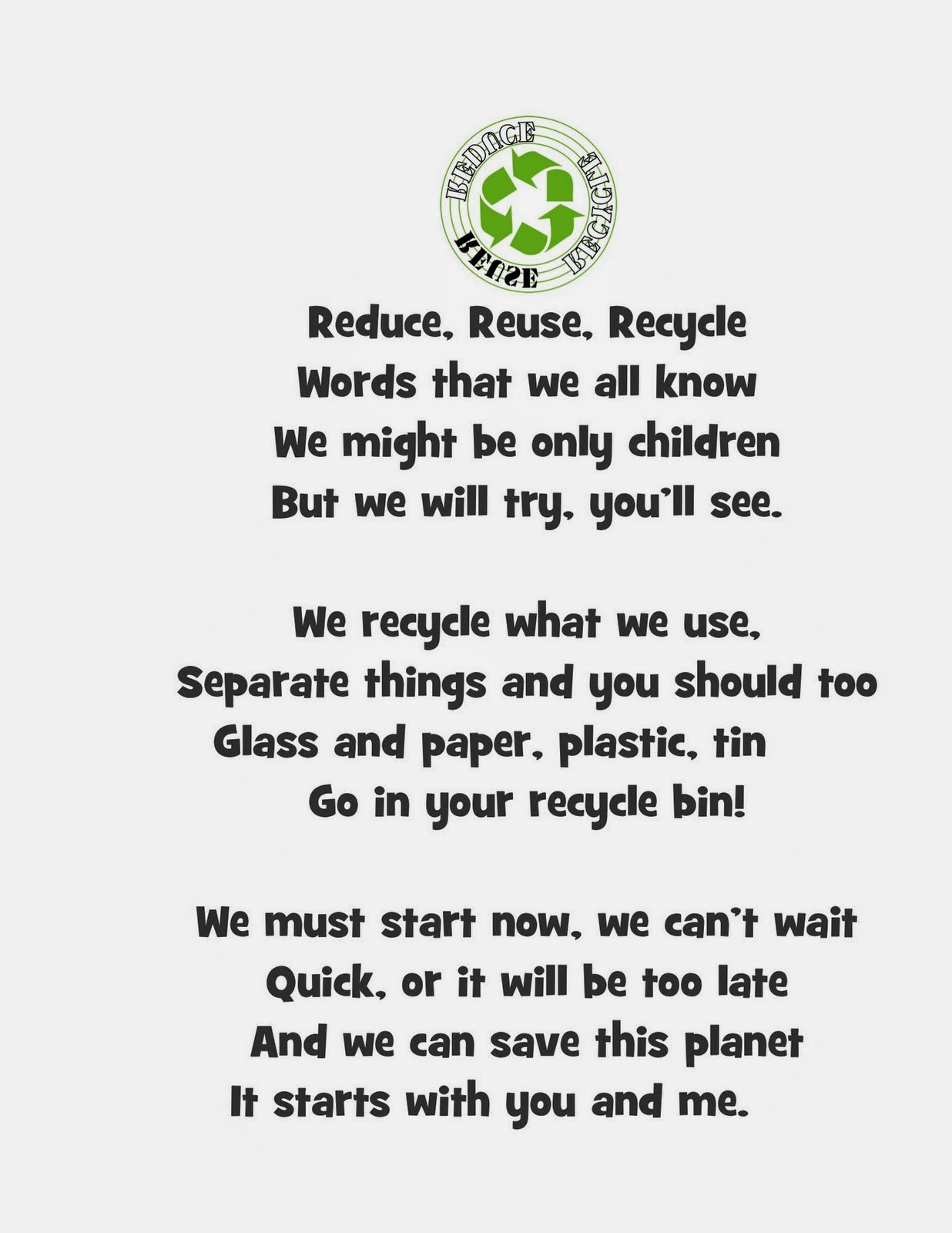
Recycling Poem and Songs


EARTH DAY MIXUP
I was telling my friend all about Earth Day
She heard me wrong and thought I said “birthday”

She said she would rush down to the mall
And buy a dollhouse or a doll

I said she shouldn’t buy all that stuff
The landfills are full of trash

Then she knew that she’d made a mistake
And said she would make a birthday cake

I cheered about that, I said “hooray!”
So that’s how we’re celebrating Earth Day

Now she’s learning about recycling trash
And not only that but she saved her cash!

What you can do
When you see litter in the streets
And the air smells of pollution
When you feel like it’s all piling up
Remember there is a solution

There’s something each of us can do
To keep the rivers clean
To keep fresh the air we breathe
And keep the forests green

Help clean a beach
Or recycle bottles and cans
Learn about the problems we face
And help other understand

It doesn’t have to be a lot
If we each just do our share
So take time out on earth Day
To show the Earth you care.


Recycling Games


-          Trash Can Relay. Set up five classroom trash cans in an obstacle course. The first student on the team runs the course, weaving in and out around the cans. When the student reaches the last can, he or she turns around and weaves back to the team. The runner taps the next team member in line, who takes his/her turn running the course.

-          Bottle Bowling. Set up bowling pins made from 2-liter soda pop bottles, small bleach bottles, or tall dishwashing detergent bottles. Tip: Put about an inch of sand in the bottom of the bottles; the pins will still be easy to bowl down, but the bottles won't fall as easily as they would if there was no sand in them. 

-          Waste No Water. Fill a clean open-topped non-breakable container (a plastic spaghetti sauce jar or a soup can work well) with water for each team; be sure the containers are the exact same size and filled to the brim with water. Set a start and finish point. At a signal, the first runner heads for the finish line, walks over the line, turns around and heads back to his or her team, and passes the container to the next person in line. At the end of the race, the team with the most water still in the container is the winner. 

-          Newspaper Relay. Provide a stack of newspapers for each team and have team members divide the stack evenly among themselves. Set up a paper bag or recycle bin (or whatever container your community uses for recycling newspaper) at a finish line. At a signal, the first member of the team carries his or her stack of newspaper to the finish line, deposits it in the container, runs back to the team, and taps the next person in line.


-          Putt for Points. Paint five coffee cans with bright colors. Paint or draw a point value on each can. (Suggestions: Paint the number 5 on one can, the number 10 on another, 15 on a third, 20 on a fourth, and 50 on the fifth.) Set up the coffee cans in a row. Give students three golf balls and three chances to accumulate points for their team. 

-          Tumbling Towers. This activity can be done one team at a time. Provide a recycle bin full of clean aluminum cans (for example, soda pop cans). At a signal, students have 2 minutes to stack the cans one atop another. Each student takes a turn at building a tower by stacking cans one atop the other. The student on each team who builds the tallest tower then represents his or her team in a final team-against-team stacking competition.

An online game

A short animated story about HOW PAPER IS MADE


How paper is made?